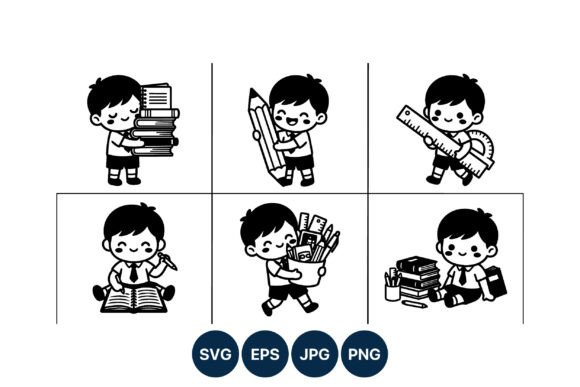
A Designer's Review: Boy Holding Books Embroidery Design
I’ve just pulled up the Boy Holding Books Pencil and Ruler embroidery design on my screen, ready to evaluate it for a real project. My client, a small boutique specializing in teacher gifts and school-themed products, needs a custom design for a series of embroidered tote bags. This black and white line art illustration immediately caught my eye. As a designer who reviews embroidery files not just for aesthetics, but for their practical performance on fabric, here’s my honest take.
The First Impression: A Quiet, Scholarly Charm
The mood here is clear: it’s a quiet, focused, and charmingly scholarly scene. The boy, engrossed in his work with a stack of books and that oversized pencil, feels nostalgic and heartwarming. The composition is dense but balanced, with the ruler, protractor, and stationery box filling the space without feeling chaotic. The level of detail in the line art is its greatest strength and its primary challenge. For us in the embroidery world, detail translates directly into stitch count and clarity.
Where This Design Naturally Belongs
This isn’t a flashy design; it’s thoughtful. It belongs on products for a specific, appreciative audience. I’m immediately thinking of personalized gifts for students, teachers, or book lovers. It would be perfect on a custom embroidered tote bag for a librarian, a sweatshirt for a graduate, or as a delicate accent on a baby’s nursery blanket for a family who loves literature. For Etsy sellers and craft business owners, this design could anchor a whole line of school-themed merchandise, from embroidered patches to apron designs for crafty educators.
Performance in Real-World Embroidery Projects
Let’s talk about how this graphics file translates from screen to stitch. On a medium to large scale—think a full-front sweatshirt embroidery or a central motif on a pillow cover—this design will shine. The separate elements like the pen tip, the book pages, and the ruler details will have space to be defined clearly with satin stitches or careful fill stitches. The black and white nature simplifies thread color selection, but it demands high contrast against the fabric background to maintain that crisp, illustrative look.
For smaller applications, caution is needed. I would hesitate to put this on a cap or a baby clothes item where the hoop size is limited. Those tiny details—the lines on the ruler, the individual books—could blur into a dense, muddy area if the stitch density is too high for a small scale. This is a design that benefits from space.
Visual Appeal and Customer Perception
From a business perspective, a well-executed embroidery of this design adds significant perceived value. It looks intentional and professional. On a handmade product, it tells a story, which enhances giftability and buyer engagement. A customer looking for a teacher’s gift will recognize the theme instantly and trust the craftsmanship if the stitching is clean. For brand consistency, a shop using this across a range of products—tea towels, blankets, holiday embroidery gifts—could build a strong, niche identity.
Careful Considerations and Designer Notes
Here’s where my practical experience kicks in. This design, with its many intersecting lines and objects, requires a thoughtful approach.
- Fabric Choice: Avoid highly textured or very stretchy fabrics for your first attempt. The detail loss would be significant. A smooth, stable cotton or canvas for that tote bag design is ideal.
- Stabilizer is Key: You will need good, firm stabilizer to keep all those elements sharp, especially on custom apparel like t-shirts.
- Test, Always Test: Run this embroidery file on scrap fabric first. Check the small details: does the pen nib look distinct? Do the book stacks read clearly? This is non-negotiable.
- Background Contrast: While it’s a black and white vector, test it in black and white mockups on both light and dark fabric backgrounds. On dark fabric, you may need to reconsider thread choices or perhaps add a light backing fabric layer for clarity.
- Commercial Use: Since this is categorised as an illustration and graphics file, before selling any finished product or using it in commercial embroidery projects, confirm the licensing terms. You need to know if you can sell the physical items you make.
A Real-Life Scenario: The Boutique Tote Bag
I’m picturing my client’s project now. I’d hoop a natural canvas tote, use a crisp white thread on the dark bag, and likely simplify some of the most minute interior lines if the machine translation makes them too dense. The final product would be a sophisticated, story-driven item perfect for a craft fair or an Etsy listing. It wouldn’t scream; it would whisper quality and thoughtfulness, which is often exactly what sells.
Final Practical Judgment
The Boy Holding Books Pencil and Ruler design is a robust, theme-rich asset for designers and makers. Its value lies in its specific charm and narrative. It’s not a universal, all-purpose graphic, but that’s its strength. For the right project on the right scale with the right preparation, it will embroider beautifully, elevate your handmade presentation, and resonate deeply with a niche audience. My advice is to embrace its detail, plan your project size carefully, and always do that crucial test stitch. Then, watch it bring a quiet, scholarly smile to your customer’s face.